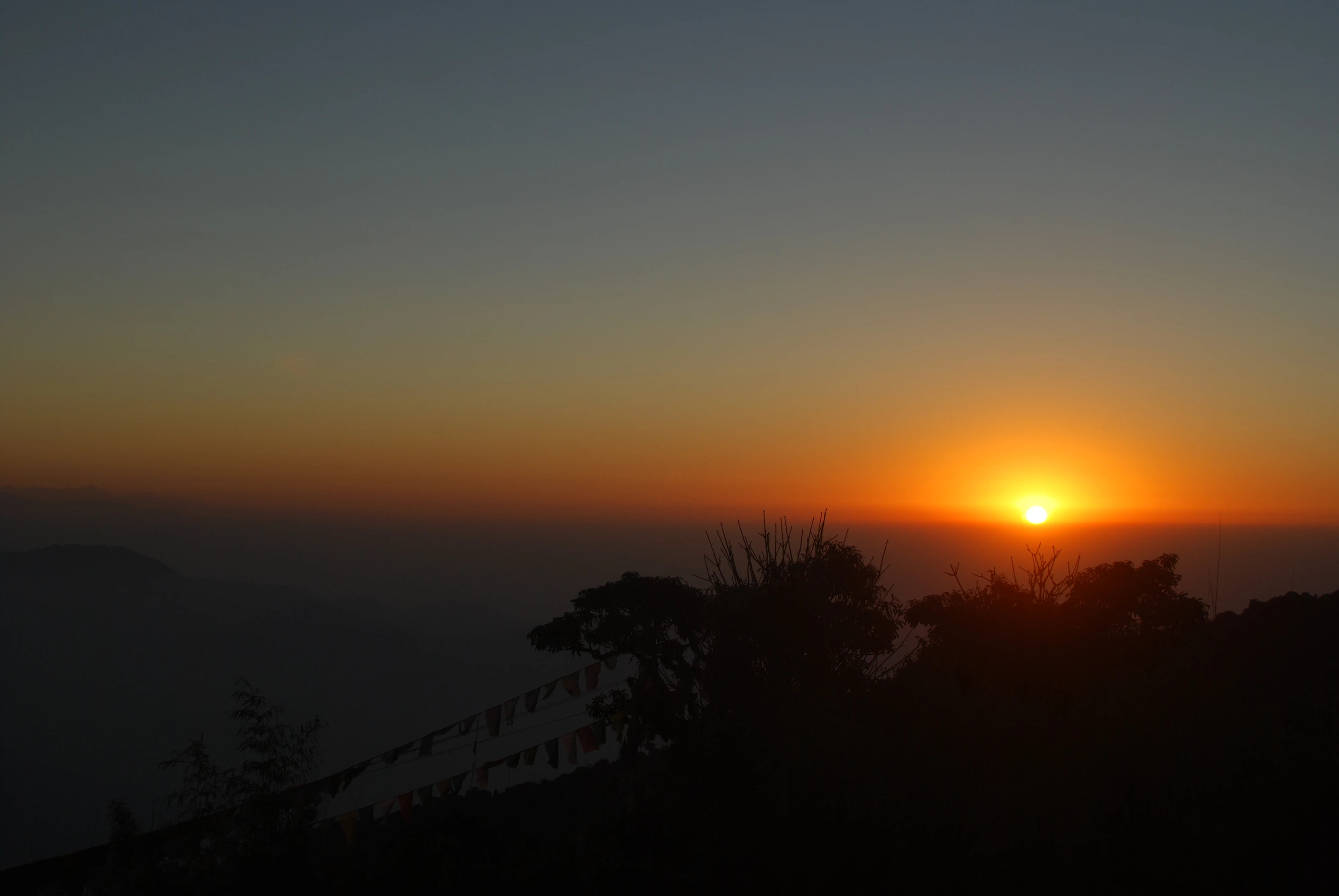
Sunrise at Tiger Hill Darjeeling
My friend Namgyal has driven this road so many times he no longer looks at it. He looks at the sky instead, at the thin band of stars above Jorebungalow, and from that alone he tells me whether the sunrise will be good.
The first morning he only said one word. Maybe.
It took three mornings, two hotel checkouts I never used, and one long argument with my own tired legs before I actually saw what everyone comes to Tiger Hill hoping to see. Not one of the guides I had read before landing in Darjeeling mentioned that the whole town runs on this kind of quiet weather prophecy passed between drivers before the sun is even close to rising.
None of them told me that getting there, staying nearby, and simply enduring the cold are not separate chapters from the sunrise itself. They are the sunrise. You do not arrive at Tiger Hill and then have an experience, the experience starts the moment you close your eyes in a cold hotel room and start listening for the sound of your alarm you already dread.
This is not a list of ten things to do near Tiger Hill. It is what actually happened across those three attempts, everything Namgyal and the people we met along the way told me in the dark, over dinner, and over cups of tea that never made it into the blogs I had read, with the full planning detail folded directly into the story so your own trip does not depend on luck the way mine nearly did.
Night One, and Everything I Got Wrong
I had booked a small heritage guesthouse two lanes off Mall Road, the kind of place with a wood stove in the lobby and a manager who writes wake up calls on a slip of paper because the landline in the rooms does not always ring. That first evening the manager insisted I eat before trying to sleep, and brought up a bowl of thukpa without really asking, thick hand pulled noodles in a cloudy broth heavy with garlic, timur pepper, and shredded chicken that had clearly been simmering since afternoon.
I ate slower than I meant to, partly from hunger and partly because the steam kept fogging my glasses in the cold room, and the manager stood by the door describing the queue at Jorebungalow like it was a living thing with moods of its own. My alarm was set for 3.40, which felt generous until Namgyal called that night to say the queue starts forming before 3.30 in late October and that we needed to already be moving by then, not waking up.
I did not sleep so much as lie under two blankets listening to the town go quiet, then hearing a stray dog bark somewhere near Chowk Bazaar, then checking my phone every twenty minutes until it finally rang for real. Somewhere in that half sleep I kept doubting the whole plan, wondering if three in the morning cold and a possibly cloudy sky were worth it at all, a doubt that would return twice more before the trip was over.
Namgyal was outside in the dark with his headlights off to save the battery in the cold, engine idling low. The moment I got in he handed me a small flask of hot ginger tea his wife had packed, said nothing about it, and simply nodded toward the road ahead as if that settled the matter of whether this was a good idea.
The drive out of town was quieter than I expected, just the two of us, the headlights, and long stretches of pine forest pressing close on both sides. Namgyal pointed toward a dark gap in the ridge and said that in his grandmother's language the whole hill we were climbing was once called Sinchyel, not Tiger Hill, a lookout point where guardian spirits were believed to watch over the passage into Mayel Lyang, the hidden ancestral valley said to lie behind Kanchenjunga.
He said most drivers repeat the tiger story without a second thought, since it is easier to explain to tourists, but his grandmother never once called it Tiger Hill in her life. She believed the observatory tower sat on what she considered the lookout's spine rather than a hill named for an animal, and that on mornings when fog swallowed the ridge completely, even against a clear forecast, the hill was simply choosing not to let anyone stare at the five sacred peaks that day.
Namgyal told me his grandmother never blamed the weather app. She blamed the hill for changing its mind.
Further along, near the turn where the road dips close to the Senchal reservoir, Namgyal slowed the taxi without being asked and pointed toward the still black water below. He told me the twin lakes were built by British engineers between 1910 and 1915 over a basin the Lepcha people considered sacred marshland, fed by an underground cold spring called Dudhey Dhara, the milk spring, whose water was once believed to turn opaque and white at the start of winter.
When engineers began blasting granite for the dam walls, he said, local laborers reportedly walked off the site, convinced the dynamite had broken the spine of the underground Nag, the snake spirit guarding the ridge's water veins. Small lead coins and brass vessels were said to be sealed into the foundation stone afterward, a quiet compromise between colonial engineering and indigenous fear that no plaque at the lake mentions today.
We were already behind Namgyal's own estimate, and true to it, Jorebungalow junction was a slow river of red tail lights by the time we reached it, taxis and shared sumos backed up from the fork in the road all the way toward the edge of town. This is the part almost no blog prepares you for, since the wait at that junction alone can burn twenty five minutes of your buffer before you have gone a single kilometer up the actual hill road.
Somewhere in that queue, with the engine off to save fuel, Namgyal finally told me about the lights. Sumo drivers on this stretch have long spoken of faint yellow lanterns floating between the oak and dhupi trees once the sanctuary gate is behind you, attributed in old Nepali folklore to the Bir Katta, headless spirits tied to colonial labor camps and forgotten border skirmishes across these ridges.
The unwritten driver rule he repeated twice, almost like it mattered more than any traffic law, was this. If you see a flicker of yellow light through the pine branches, you never honk, you never slow down, and you never stop to check if someone needs help, because acknowledging the light is believed to stall your engine on the incline.
Once through the sanctuary gate the temperature dropped fast enough that I regretted not layering earlier, and if your vehicle is not already inside that queue by roughly 3.40 in peak season, you risk reaching the pavilion only after the light has already started shifting from black to grey. That first morning, we reached the base of the tower with barely twelve minutes of true darkness left.
At the ticket counter, huddled with strangers doing the same nervous shuffle to stay warm, an older forest warden waiting near the gate mentioned almost in passing that Tiger Hill had once been a survey station for the British in the 1840s, long before anyone came here for a view. He said a young native surveyor's assistant had slipped from an ice covered observation rig during an unseasonal November storm while guarding brass theodolite instruments, and that forest staff camping near the old Senchal tower still claim to hear, during heavy pre dawn squalls, the rhythmic snap of a canvas survey flag long after every modern flag and pavilion has been locked down for the night.
By the time we climbed to the railing the eastern sky had already gone the color of wet ash and stayed there, thick and unmoving. No sunrise came, just a slow lightening into an ordinary grey morning, hundreds of disappointed faces around me, and Namgyal shrugging like this happens more often than any of us would like to admit.
We did not waste the trip back, since Namgyal took the longer return route through Ghoom, and it turned out to matter more than the failed sunrise. Ghoom Monastery was already opening its gates, incense smoke moving low and thick in the damp air, monks going through their morning routine with a stillness that had nothing to do with tourists at all.
Just outside, a small roadside stall was already frying momos for the early crowd, and Namgyal insisted we stop, saying no first Tiger Hill morning should end without them. They came out pan fried rather than steamed, the skin blistered and slightly crisp, filled with minced pork and a sharp green chutney made from tomato and dried chili that stung more than I expected at that hour, eaten standing up with cold hands wrapped around the paper plate for warmth.
While we ate, the stall owner mentioned, almost casually, that children in the villages around Jorebungalow and Ghoom are still warned about a bird like whistle that comes from tree level rather than the ground. This is attributed to the Ban Jhakri, the primordial forest shaman of Himalayan belief who is said to select certain children and teach them botanical and spiritual healing secrets over days of disappearance.
His counterpart, Lyamlyamey, is described as a hairy forest witch with backward pointing feet who mimics human voices or the snap of dry pine twigs to draw solitary walkers off the trail and toward the ravines. Namgyal laughed at this one, but later, on the walk back to the taxi, he still would not let me trail behind alone in the dark.
From there we dropped toward Batasia Loop, where the mist made the war memorial and the spiraling railway track look almost unreal, more atmospheric in the fog than any photograph of the clear version I had seen online. It was the first sign that a clouded sunrise is not a failure so much as an incomplete plan, and that the descent itself deserves as much attention as the climb.
Night Two, Sleeping With One Eye on the Sky
The guesthouse manager, half amused, told me the second morning would likely be worse before it got better, since a fresh bank of cloud was expected to sit over the ridge through the following afternoon. I stayed anyway, moved my checkout back a day, and spent the day walking Mall Road half distracted, checking the sky every time it changed color even slightly.
That evening the manager brought up a plate of thenthuk instead of thukpa, flat hand torn noodle squares in a lighter vegetable broth, alongside a small jug of tongba, warm fermented millet beer sipped through a bamboo straw from a wooden vessel that got refilled with hot water each time it ran low. It was the first time all trip I actually felt warm from the inside rather than from layers.
Namgyal called that evening to say we should still try, not because the odds were good but because he wanted me to see the process at least once without the pressure of it being my only chance. My doubts had grown heavier by then, the kind of tired second guessing that comes from one failed morning already behind you and a second one you are not sure is worth the cold.
We left at 3.30, ten minutes earlier than the night before, and the queue was somehow worse, easily forty vehicles deep by the time we reached the fork. Namgyal used the wait to point out the exact stretch of cliff where an old black river stone once sat near a former horse stable, known among porters as a Kichkandi's seat, a spot women were once told never to walk past alone after dusk.
The Kichkandi, he explained, is the restless spirit of a woman who died an untimely or violent death, appearing as a striking woman wrapped in an old woolen shawl whose feet point backward and who leaves no footprints in the morning mud. The stone itself was pushed over the cliff edge decades ago during road widening, yet he admitted, almost sheepishly, that he still never idles his engine alone at that junction past midnight.
At the tower itself I finally understood the ticket structure properly, because Namgyal walked me through it while we stood in line. The open ground level along the outer railing is the cheapest option and also the most exposed, both to wind and to the crowd pressing in from every side, while the first floor pavilion costs a bit more and buys you elevated seating with a little shelter from the worst of the wind.
The top floor lounge, the most expensive tier, is partially heated with proper seating and the least obstructed sightline, and on a crowded peak season morning it is often the only tier where you can comfortably hold a tripod steady without being jostled. None of these fees are fixed for long, since local administration revises them almost every season, so the wisest approach is to treat the tiers as a comparison of comfort and confirm the current rate directly at the gate counter.
That second morning gave us a partial break in the cloud, enough to see a pale gold smear where the summit should have been but nothing close to the full alpine glow. Namgyal called it a half sunrise, which felt like the right description for how disappointed and relieved I felt at the same time.
On the drive down, deep inside the sanctuary where the trees pressed close on both sides, Namgyal slowed again and told me about the bears. Senchal is one of the oldest wildlife sanctuaries in India and still shelters the elusive Himalayan black bear, and village hunters and foragers share a belief that these bears are occasionally seen climbing the crags near Tiger Hill just before sunrise in late autumn, not out of hunger but to catch the first flash of light striking Kanchenjunga.
Hill folk call that early alpine glow Deo Ka Mukhar, the face of the god, and believe wild animals climb to high ridgelines to bathe their eyes in the first crimson ray before the long hibernation of winter. Seeing a bear's silhouette on an adjacent ridge at dawn, Namgyal said, is traditionally considered the highest possible omen of long life and safe travels, and he seemed almost disappointed we had not spotted one that morning.
We stopped for breakfast at a small wayside dhaba near Ghoom that Namgyal clearly visits often, judging by how the owner already had our order half guessed before we sat down. Sael roti arrived first, a soft ring shaped rice flour bread lightly sweetened and fried until the outside crisped, served with a runny potato curry and more of the same strong milk tea everyone in these hills seems to drink by the liter.
The owner, overhearing Namgyal mention Tiger Hill, mentioned an old ridge path that most tourists never hear about at all, called locally the Chura Khet trail, once used by villagers from Rangbhang, Lopchu, and the fringe tea gardens to reach the summit on foot long before the paved Senchal road existed. It was a pre dawn route for hill runners and tea carriers moving dried rations and block tea between military outposts and border hamlets, marked along the way by small spiral signs carved into flat sandstone blocks that locals still say were left by early Lamas traveling between Sikkim and Mirik to mark spots where caravans once froze in sudden altitude drops.
He warned, only half joking, that people still avoid stepping onto the moss covered stone clusters along that ridge, treating them as an unmarked collective memorial rather than a place to rest or take photographs. At Batasia Loop on the way back, the mist had cleared just enough for Namgyal to point toward the drainage gullies beneath the track, where older rail workers still speak of tunnels sealed after landslides trapped laborers in the early 1900s, and where night watchmen occasionally claim to hear the rhythmic clink of pickaxes on granite when the mountain goes completely silent before dawn.
Night Three, and the Version I Had Actually Come For
By the third evening I had stopped trusting my own read of the sky and started trusting Namgyal's instead. He came by the guesthouse in person rather than calling, looked at the thin, clean line of stars above the rooftops, and said only that tonight felt different, without explaining why.
Dinner that night was simple, just a plate of momos again, this time steamed rather than fried and filled with vegetables and paneer, alongside a bowl of clear soup the guesthouse called momo jhol, thin and peppery, meant to warm the stomach before a cold night rather than fill it completely. I ate slowly, half distracted, watching the same stretch of sky the manager kept glancing at from the window.
We left at 3.15, the earliest of the three mornings, specifically to beat the queue before it built, and it worked. We were inside the Jorebungalow queue within the first fifteen vehicles rather than the fortieth, and the drive up this time felt different too, quieter, less like waiting and more like actually arriving somewhere.
Namgyal did not tell any story on the way up that night. He simply drove, humming something under his breath that I did not recognize, and I found myself watching the tree line instead of my phone, half hoping to see a flicker of yellow light I would then have to pretend I had not seen.
We reached the tower with close to forty minutes of darkness still ahead of us, and standing at the railing that third time felt different from the moment I stepped out of the taxi. The cold was sharper than either previous morning, cutting through my windcheater at the wrists and collar until I finally understood why every local vendor nearby was doing brisk business in hot tea and roasted corn rather than souvenirs.
I bought a cup of that tea mostly for the warmth of holding it, thick with condensed milk and a strong hit of cardamom, and a small paper cone of roasted corn rubbed with lime and chili salt that I ate more out of nervous habit than hunger. Namgyal, standing beside me, mentioned quietly that most sunrise photographs chase the golden pink glow on the summit, but that in local mountain faith Kanchenjunga is treated as a living deity holding five treasures, salt, gold, gems, sacred scriptures, and divine medicine.
He said that on rare mornings, hill shamans describe the mountain not reflecting light at first but casting a sharp black shadow into the pale sky just before sunrise, an inversion some Jhankris treat as an opening of the spirit doors, during which a quiet prayer is whispered before looking directly at the crest. He did this without announcing it, and I only noticed because his lips were moving and his eyes were closed for the two seconds before the light actually broke.
I kept my own eyes closed for long stretches too, less from tiredness and more because Namgyal had told me the light changes fastest in the final few minutes. Closing your eyes and reopening them, he said, lets you actually feel the shift rather than only watching it incrementally.
When I opened them the third time, the sky above Kanchenjunga had gone from ash grey to a deep rose that spread outward faster than I expected. Then, in a matter of seconds, the summit itself lit up in a color that photographs genuinely do not prepare you for, closer to burning copper than the soft pink most postcards suggest.
It is worth being honest here about what you are actually looking at once that light breaks. Kanchenjunga dominates almost the entire visible range and is what most of your photographs will hold, close, immense, and impossible to miss.
Everest, by contrast, appears only as a small, distant point far toward the western horizon, and a large number of first time visitors misidentify it, assuming the largest shape in their frame must be the world's tallest peak when it is in fact Kanchenjunga sitting much closer to the viewing tower. If photography matters to you, a focal length somewhere in the 70 to 200mm range compresses the Kanchenjunga range beautifully during that first burst of alpine glow, while a wider lens suits the crowd and pavilion scene itself, which has its own chaotic charm worth capturing.
Tripods are workable near the outer railing edges but space is genuinely tight during peak season, which is exactly why arriving early enough to claim a spot mattered more on that third morning than any piece of gear I had packed. Somewhere behind us, someone in the crowd actually pointed toward an adjacent ridge and swore they had seen a dark shape moving along the rocks, and I thought immediately of Namgyal's bear story from the night before, though neither of us could confirm it was anything more than a trick of the fading shadow.
What actually made the third morning work
Leaving by 3.15 instead of 3.30 to enter the Jorebungalow queue among the first arrivals rather than the middle of it, choosing a tier with less wind exposure after two cold mornings, and trusting Namgyal's reading of the sky over any app on my phone.On the descent that final time neither of us wanted to rush, so we lingered longer at Ghoom Monastery than either of the previous mornings, and Namgyal pointed out a smaller side shrine most tour groups walk past entirely because their driver is on a schedule and theirs was not. We stopped once more at the same momo stall from the first morning, and this time celebrated with a full breakfast of eggs fried in mustard oil, thick slices of toast, and yet another round of milk tea that tasted better than any of the previous two mornings combined, purely because of what it followed.
At Batasia Loop the mist had cleared just enough to see the full spiral of track against the mountains behind it, something neither of the two foggy mornings had allowed. Driving back into town, past shopkeepers only just opening their shutters and school children walking in twos toward Loreto Convent, I found myself replaying the whole three days rather than looking forward to sleep, the failed grey mornings suddenly feeling like they mattered as much as the successful one.
We reached Chowrasta a little after seven, and the last thing Namgyal said before driving off was that the hill had decided to let us see it that day, as though the sighting itself were a kind of permission rather than a simple weather outcome. I do not know if I believe that the way his grandmother did, but after three mornings of trying I have stopped assuming a clouded sunrise is only ever bad luck, and I no longer plan a Tiger Hill trip around a single attempt.
Practical takeaway for your own planning
Build at least two mornings into your Darjeeling itinerary if the sunrise genuinely matters to you, not one. Shared jeeps from Chauk Bazaar or Mall Road cost far less per person than a reserved taxi but offer less flexibility on the return leg, while a reserved taxi is usually shared informally among four to six travelers splitting the fare, arranged the night before through most guesthouses. Specifically request a driver who includes Ghoom Monastery and Batasia Loop on the way back, since not every driver offers this unless asked, and it is precisely what turns a foggy morning into a full one rather than a wasted one.Reading the Odds Before You Book
| Season | Leave Darjeeling town by | Sunrise window | Rough odds of a clear view |
|---|---|---|---|
| October to November | 3.15 am | 5.40 to 6.05 am | High |
| December to February | 4.30 am | 6.10 to 6.35 am | Moderate, cold but often crisp |
| March to April | 3.45 am | 5.10 to 5.35 am | High |
| May to June | 3.30 am | 4.45 to 5.05 am | Moderate, haze increasing |
| Monsoon, July to September | Not recommended | Visibility rarely permits a clear view | Low |
Across a full year, roughly six out of ten mornings at Tiger Hill do not deliver a textbook clear sunrise, which is exactly why my own experience took three attempts rather than one. October, November and the pre monsoon stretch in March and April carry the best odds by a clear margin, and if your travel dates fall outside those windows it is worth mentally preparing for the descent through Ghoom and Batasia Loop to be the actual highlight rather than a backup plan.
Mapping the Full Route
The loop we drove each of the three mornings
Darjeeling Mall Road to Jorebungalow Junction, then uphill through Senchal Wildlife Sanctuary to the Tiger Hill observatory tower, elevation approximately 2590 meters. On the return, Ghoom Monastery, followed by Batasia Loop, then back into Darjeeling town. The full loop typically takes three to four hours depending on queue time at Jorebungalow and how long you choose to linger at the two return stops, and on our third and most successful morning we stretched it closer to four hours simply because neither of us wanted to hurry.What to Actually Pack
Temperatures at the pavilion routinely sit well below what the town itself feels like, and the wind along the outer railing cuts through a single jacket faster than most visitors expect, something I learned the hard way on the first two mornings. A proper windcheater, thermal layers underneath, gloves, and a cap matter more than most packing lists suggest, and carrying small cash is genuinely useful for hot tea, roasted corn, and toilet access near the base of the tower, none of which reliably accept cards.
Before You Go
If there is one thing I would tell anyone booking this trip, it is to stop treating Tiger Hill as a single scheduled event squeezed between dinner and a flight home. Give it room to fail once or twice, and give yourself a driver who tells you honestly when the odds are against you rather than one who simply takes your money and drives up regardless.
And when the light finally does break through, whether on your first morning or your third, let yourself stand there a little longer than feels necessary before reaching for your phone to photograph it.
Frequently Asked
Can you actually see Mount Everest from Tiger Hill
On a very clear day a small distant peak is visible toward the western horizon and guides will point it out as Everest, but it sits far behind closer ranges and looks modest next to the much closer bulk of Kanchenjunga.
Is Tiger Hill worth visiting if the morning is foggy
Yes, provided the return route through Ghoom Monastery, Batasia Loop and Senchal Wildlife Sanctuary is treated as part of the plan rather than a fallback.
What time should you leave Darjeeling town
Between October and April, 3.30 am from Mall Road is the safer call because of the taxi queue at Jorebungalow, while quieter months allow leaving closer to 4.15 am.
Gorgeous sunrise from Tiger Hill
This is gorgeous!!
SWF
That is beautiful--nice shot. Mickie ;)
What a wonderful vantage point for watching the sunrise! I am so glad I clicked on your photo to see the larger version, because not only did I then see Mt. Everest, I was also able to see the two rows of prayer flags silhouetted against the dawn sky. Such a magical photo from such a wonderous place. Thanks for making the 8,500 foot climb to capture and share it with the rest of us! :-)
Wonderful scene.
Regards!